
What are learning disorders?
Learning disorders represent a major public health issue. They affect an average of 16 to 24% of students in Europe. In Réunion, the proportion of children with learning difficulties is much higher, around 25 to 30%.
They often precede sometimes irreversible school failure, leading to illiteracy and impossible social integration.
Causes:
– Sensory impairment (visual, auditory)
– Intellectual disability, high intellectual potential (“gifted”, “precocious”)
– Psychological or psychiatric disorders
– Socio-familial difficulties, abuse
– Autism spectrum disorders with or without intellectual disability
– Neurological conditions (epilepsy, acquired or congenital brain lesions, etc.)
– Specific language and learning disorders (“DYS”):
- Dysphasia (specific disorder of oral language)
- Dyslexia (specific disorder of written language: reading, spelling)
- Dyscalculia (math learning disorder)
- Dyspraxia (disorder of coordination and planning of movements)
- Attention deficit disorder with or without hyperactivity (ADHD)
Diagnosis and support
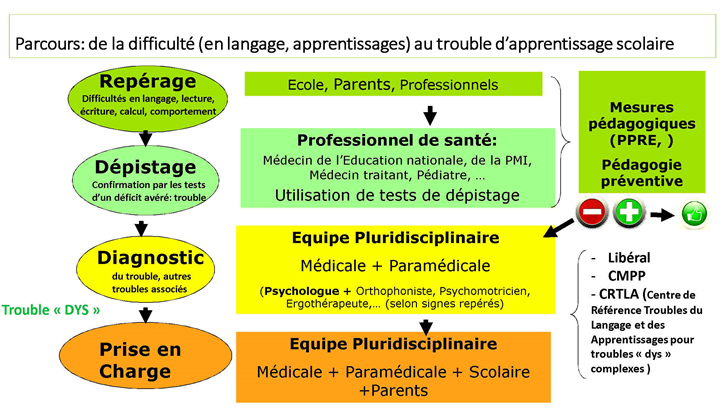
Diagnosis of the disorder and any associated conditions, as well as assessment of severity, relies on a rigorous, stepwise, multidisciplinary diagnostic approach.
This allows for the provision of tailored interventions (initially educational alone or educational combined with therapies such as speech therapy, psychomotor therapy, etc.) for each child, as close as possible to their needs.
The measures provided must be regularly reassessed and adapted based on their effectiveness, changes in the clinical picture, the child’s needs, and the progress of the diagnostic process.
The pathway for a child with school learning disorders is summarized below: